Telecommunications Data and the Changing Architecture of Credit
How telecommunications data can support credit decisions within operator ecosystems and across independent financial institutions.

Across the floor of the Atlantic Ocean, thousands of kilometres of fibre-optic cables carry information between Africa and the rest of the world.
On land, these cables connect to networks that run through cities, across highways, and into communities separated by extraordinary distances. Above them stand tall telecommunications towers, transmitting signals that connect hundreds of millions of people across a continent of immense geographic scale.
Over the last two decades, the expansion of these networks has transformed how Africa communicates, transacts, and participates in the economy. Mobile money has become critical financial infrastructure in several markets, while payments, commerce, and everyday services increasingly operate through digital systems capable of supporting economic activity at extraordinary scale.
What began primarily as infrastructure for communication now supports systems through which people can store value, transfer money, receive payments, and access credit.
Across several African markets, telecommunications and mobile-money providers already lend through financial products offered within their ecosystems, drawing on customer relationships, information resources, and institutional partnerships.
As these financial services develop, another opportunity becomes increasingly relevant: the application of telecommunications-derived intelligence to a wider range of credit decisions, both within operators' own ecosystems and across independent financial institutions.
From Network Behaviour to Credit Intelligence
Depending on the market and services offered, telecommunications operators may have access to call detail records (CDRs), airtime top‑up histories, service-usage patterns, subscriber tenure data, and (where they provide it) airtime-advance/credit records, each offering a different lens on customer behaviour over time. Where mobile money is part of the operator’s ecosystem, transaction and payment activity can provide additional, complementary signals.
Some of these records can be especially relevant in markets where conventional credit histories and documented income provide an incomplete picture of the populations financial institutions intend to serve.
Their value lies in whether patterns within them can improve the assessment of repayment risk. Recharge behaviour, for example, may reveal consistency in certain spending patterns, while airtime advance histories may provide evidence about how particular service-related obligations have been managed.
These observations do not independently establish creditworthiness. Their relevance must be validated against lending outcomes, within the populations and credit products for which they are intended.
This is where Alternative Data Intelligence, or ADI, becomes important.
ADI applies analytical and artificial intelligence capabilities to non-traditional economic indicators, identifying and validating patterns that improve an institution's understanding of credit risk.

For telecommunications companies, the resulting intelligence has applications wherever their information can help institutions make more informed lending decisions.
The Expanding Applications of Telecommunications Credit Intelligence
One application already exists within telecommunications and mobile-money ecosystems, where network-derived and transactional intelligence can support the assessment of customers, the determination of credit limits, and the development of lending products.
But these applications need not be confined to the operator's own financial-services business.
Consider a bank seeking to expand lending into a customer segment its existing underwriting models cannot adequately assess, or one looking to improve risk differentiation across an established portfolio.
Both objectives depend partly on the institution's ability to understand repayment risk across the populations it intends to serve.
Intelligence derived from telecommunications relationships can improve those assessments, allowing the bank to evaluate opportunities its existing information does not sufficiently explain.
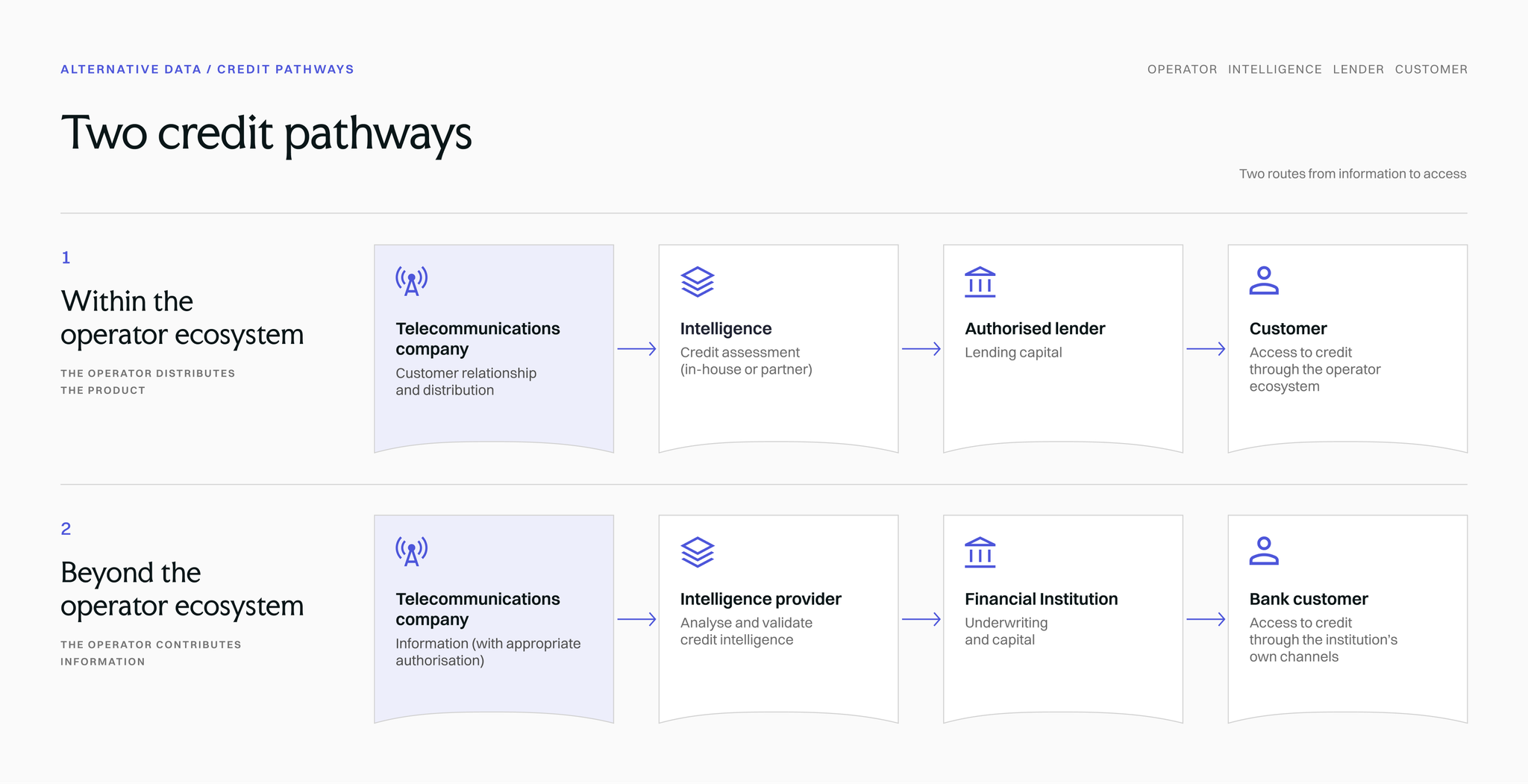
Through an appropriately authorised partnership, a telecommunications operator can contribute relevant information, a specialised intelligence provider can develop and validate credit-risk assessments, and the bank can incorporate the resulting intelligence into its own underwriting systems.
The operator thus becomes relevant to the bank's credit expansion or portfolio optimisation strategy, independently of the lending products it may already offer within its own ecosystem.
This extends the commercial relevance of telecommunications information across a broader institutional credit market, where different financial institutions can apply appropriately validated intelligence to their own lending objectives.
Making Telecommunications Intelligence Institutionally Useful
The strategic value of telecommunications data, however, depends on the conditions under which it can be converted into reliable, decision-relevant credit intelligence.
Telecommunications data is generated primarily to support network operations and customer services. Its application to lending requires lawful access, reliable processing, validated models, and the ability to associate relevant information with the populations being assessed.
The intelligence must also work within the institution's decision-making environment. Credit policies, integration requirements, risk appetites, and regulatory obligations differ across lenders, making the development and deployment of dependable intelligence an important part of the infrastructure.
Specialised Alternative Data Intelligence providers can help connect these capabilities, developing relevant network and transactional information into credit assessments that financial institutions can incorporate into their lending operations.
The commercial significance is the additional range of credit opportunities that can be built around information generated through telecommunications networks and financial services.
An operator may use that intelligence to improve products offered within its own ecosystem. It may also participate in the credit expansion and portfolio strategies of banks and other lenders operating independently.
The economic opportunity in either arrangement depends on the quality of the intelligence, the institutional demand it serves, and the partnerships capable of putting it to work.
For an industry that has spent decades expanding connectivity and building customer relationships across Africa, this introduces another dimension to the value of its infrastructure.
The information generated through telecommunications networks can become a capability through which operators participate in credit decisions across a wider financial system.
Exploring Credit Intelligence with Notto
Notto builds alternative credit infrastructure that helps institutions turn non-traditional economic information into reliable credit assessments and deploy that intelligence within their lending systems.
For telecommunications and mobile-money operators, this creates opportunities to strengthen credit products within their own ecosystems and establish intelligence partnerships with financial institutions serving broader markets.
We work with institutions to explore these applications, from identifying relevant information and validating credit-risk signals to developing the intelligence and deployment arrangements required for responsible lending.
If your organisation is exploring either application, book a demo to explore how Notto's intelligence infrastructure could support your organisation's credit opportunities.